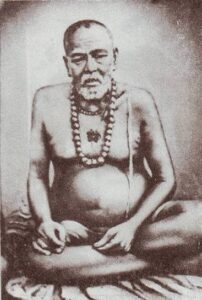
 Sadhak Bamakhepa, was one of the most powerful tantric saints of Bengal. He was not only a worshipper of the fierce Mother Goddess Tara but also a siddha of the avadhūta order.
He was Born in the early 19th century in the village of Atla near Tarapith. His real name was Bamacharan Chattopadhyay . From a very young age, he swas drawn to sadhus, mantras, and stories of Maa Tara. He would often wander off to cremation grounds and remote places to meditate in solitude. What seemed like madness to the world was, in fact, the beginning of his deep inner awakening.
He came under the guidance of Sadhak Kailashpati, a powerful avadhūta who lived in the cremation ground of Tarapith. Kailashpati was known to be a tantric, deeply immersed in the Kaula and Vamachara streams of tantra. He accepted Bamacharan as a disciple and initiated him into the esoteric path of Shakta sadhana. Under his guru’s stern but silent guidance, Bamacharan performed severe austerities sometimes living without food, meditating for days, practicing rituals with skulls and ash in the burning ground, calling upon Maa Tara with desperate longing.
In time, Bamacharan attained siddhi and became known as Bamakhepa ‘Bama’ referring to the left-hand path (Vamachara), and ‘Khepa’ meaning mad, though not with delusion but divine intoxication. His life from then on became inseparable from the temple and cremation ground of Tarapith.
Unlike temple priests, who followed strict codes and rituals, Bamakhepa would enter the sanctum of Maa Tara as if She were his mother. He would sit on the very altar, speak to Her, eat Her offerings, and sometimes scold Her like a child to his mother. For this, he was at times beaten by the temple authorities. But legends say that Maa Tara appeared in the dreams of the priests and warned them that Bama was Her true devotee. From then on, he was revered as a living saint.
Bamakhepa’s guru parampara belonged to the stream of Shakta tantra rooted in the cremation-ground traditions of Bengal. These lineages were rarely recorded in written genealogies, but were passed orally and through direct experience from guru to śiṣya. Kailashpati, his guru, was said to be connected to an earlier line of Kaula avadhūtas who had settled around Tarapith and Kankalitala. Though these gurus often wandered in anonymity, their spiritual power was transmitted through shaktipāta and intense sādhanā in secret.
Bamakhepa had several disciples. While many of them were anonymous tantrikas and wandering monks, a few names have been preserved through oral history and local lore. Among them was Sadhak Mokshadananda, a renunciate who became a key figure in carrying forward his guru’s tradition. He stayed in Tarapith and guided new aspirants, teaching them the principles of Shakta sadhana and preserving the oral teachings of Bamakhepa.
Another disciple was Shibnath, known for his reclusive nature and strict practices. He was said to have mastered several tantra texts and would rarely speak, living on alms and staying close to cremation grounds.
There were also householder disciples who came to Bamakhepa for spiritual guidance. One such person was Gadadhar Mukhopadhyay, who maintained a written record of Bamakhepa’s sayings, visions, and miraculous events. It is through these writings and oral tales passed down in Birbhum that we know much of what survives today about the saint’s life.
Bamakhepa’s way was not easy. His path required total surrender, fierce detachment, and a fearlessness that could only be sustained by grace. To the world, he looked like a madman. But to those who could see beyond the surface, he was a living embodiment of divine love, immersed in the raw and intimate relationship between bhakta and Devi.
Even today, at Tarapith, devotees recall his presence. His samadhi stands close to the cremation ground where he performed his tapasya. Pilgrims come not only to see the temple of Maa Tara but also to bow before the memory of the saint who became one with Her.
Bamakhepa reminds us that the divine does not merely found in temples or rituals but often in the deepest silence of surrender, in the terrifying beauty of the “cremation ground”, and in the mad laughter of those who have lost themselves completely in the love of the Mother.
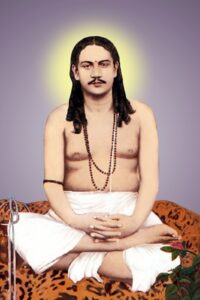 Paramahansa Sri Sri Nigamananda Saraswati Deva was born in a bramhin family at Qutabpur in Nadia district (now in Bangladesh) in the year 1879. His father Bhuban Mohan Bhattacharya and mother Yogendra Mohini had named him ‘Nalinikanta’. As he grew to boyhood, Nalinikanta drew admiration of the people for his extraordinary fearlessness, intelligence and forthrightness. Leadership was natural to him. Nalinikanta was especially dear to his mother. As the fate would have it the mother of Nalinikanta breathed her last immaturely from a brief illness. At that time, Nalinikanta was pursuing his primary education in his maternal uncle’s village Radhakantapur. Her death deeply shocked Nalinikanta as he was very much devoted to his mother. He came to know that just before she breathed her last, his mother had handed over his charges to the ‘Jaganmata’ the ‘Cosmic Mother’. He took the words of her mother to be literally true. As he was desperately in need of a mother, he single-heartedly prayed to the ‘Jaganmata’ to appear before him. But alas! He failed to get a glimpse of ‘Her’ even in his dreams. He lost faith in God thinking that God does not exist, the religious rites and spiritual practices are worthless activities, and all those sadhus, ascetics or renunciates are lazy worthless cheats. His belief in God was shaken to such extent that he turned extremely antagonistic towards everything related to Him. Especially, the sadhus and the wandering ascetics used to face most of his ire. He convinced to himself that ‘death’ is the ‘end’ of everything in one’s life. Thereafter he decided for himself that – religion to him would be nothing other than ‘doing good to the fellow beings’, and his duty is to lead a disciplined and virtuous life. During his school days Nalinikanta used to read textbooks that the ‘Sun’ is a gigantic ball of burning gases and the ‘Moon’ and the other planets are composed of gross matters such as dust and rocks. He used to feel a pinch in his heart when his fellow countrymen were jeered at as superstitious folks paying obeisance to these insentient planets. Even though he had lost faith in God and religion, he used to wonder how all those ancient Rishis (seers) of his land could go wrong in putting such significance on these heavenly bodies. Later, during his sadhak (spiritual practitioner) life, he was delighted to find that thousands of years before Newton, the ancient Rishis of India knew the science of space and the principles of gravitation. His heart was urging him to spread the knowledge and ideals of those ancient Rishis among his fellow beings.
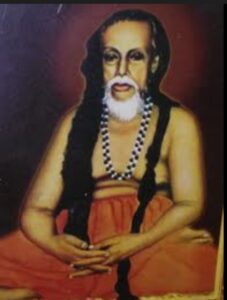 Parivrajakacharyabar Shri Shri Durgaprasanna Paramhamsadev was born to Umacharan Chakrabarti (a siddha tantrik sadhak in the lineage of Advaita prabhu) and Chintamani Devi (a steadfast devotee of Lord Ashutosh) in Rajapur village under the district of Barishal (presently in Bangladesh) on the auspicious day of Raas Poornima in the year of 1891 (b1298).
His Kundalini Shakti got awakened at the sacred thread ceremony itself. He got success (siddhi) in Gayatri Sadhana at the age of seventeen. He attained the holy vision of Goddess Kali one moonless (amavasya) night on the Panchamundi aasan (five-headed seat) established by Sarvanand at Kumilla Meher’s Kalibari. Besides these he also learnt and practiced to perfection many other sadhanas just for the sake of reducing the agony of mortals. He used to offer ayurvedic medicines to people to cure their illnesses and his own belongings to the poor.
Since his early childhood, he nurtured the spirit of service towards every fellow-being. His eagerness to remove forever the sufferings of all brought him to his guru Shri Shri Nigamananda Paramhamsa (then reciding at Assam Kokilamukh Shanti Ashram) who immediately identified him as a Vishwa-Sevak (universal servant) and later guided him through various spiritual austerities (details are unknown) finally asking him to be a Guru himself, which he reluctantly accepted.
Durgaprasanna was a dedicated disciple of his gurudev and soon he became his dearest. Nigamanandaji sent him home on his father’s fervent request and told him to continue his spiritual exercises at his home. He got siddhi in his ishta-mantra at his Rajapur home by having a vision of his gurudev’s divine manifestation.
After this success he was conferred the right of being a Guru, give Diksha and accept disciples. But soon he finds himself unable to confront worldly matters that his disciples tried to share with him. He gave up and put his expressed his problem to his gurudev who then sent him for a special sadhana at Daam pahar which he completed successfully and returned.
According to Nigamanandaji’s instructions, he also practiced shav-sadhana(tantrik practice with corpse) and later after parting from gurudev, he practiced yog-sadhana through which he first reached savikalpa samadhi and explored all the fourteen worlds (chaturdash-lok) in the universe along with realization of the soul (Aatman).